Vision Before Technology: Why Most Tax and Estate Firm Marketing Fails
Vision Before Technology: Why Most Tax and Estate Firm Marketing Fails
Vision Before Technology: Why Most Business Marketing Fails (And What to Build First)
Why companies across every industry keep investing in marketing, tools, and automation, and still don’t get the results they expect.
Vision → People → Process → Technology
Get the order wrong, and you rebuild every six months.

If you run a business, you’ve probably tried at least one of these:
A new website
A CRM or automation platform
A marketing agency or consultant
Content support or AI tools
A follow-up system your team was supposed to use
And six months later, the result usually looks like this:
The messaging still feels generic
The website looks good but attracts the wrong people
Follow-up feels mechanical, so it gets ignored
The team is busy, but nothing feels consistent
Someone says, “Maybe we just need better tools”
Here’s the hard truth.
It’s almost never the tools.
It’s the sequence.
I’ve been building systems, process infrastructure, and automation frameworks since the early 1990s. Document management. Media. Advertising. Professional services. Different industries, different technologies, same failure pattern.
Most businesses don’t fail because they picked the wrong software.
They fail because they built on a foundation that was never defined.
The Backwards Approach
Most businesses build in this order:
Technology → Process → People → Vision
They buy tools first.
Then they try to design a process around the tools.
Then they realize the team doesn’t know who they’re really trying to serve.
Then, if they’re lucky, someone asks, “What are we actually trying to achieve here?”
By that point, months are gone. Budgets are burned. Systems are brittle.
You didn’t fail.
The sequence failed you.
Why This Pattern Repeats
This happens because you can only copy what you can see.
When you look at a successful business, you see:
Their website
Their marketing
Their CRM
Their automation
What you don’t see is what actually made those tools work:
The Vision that guided decisions
The People they were built to serve
The Process that created trust and momentum
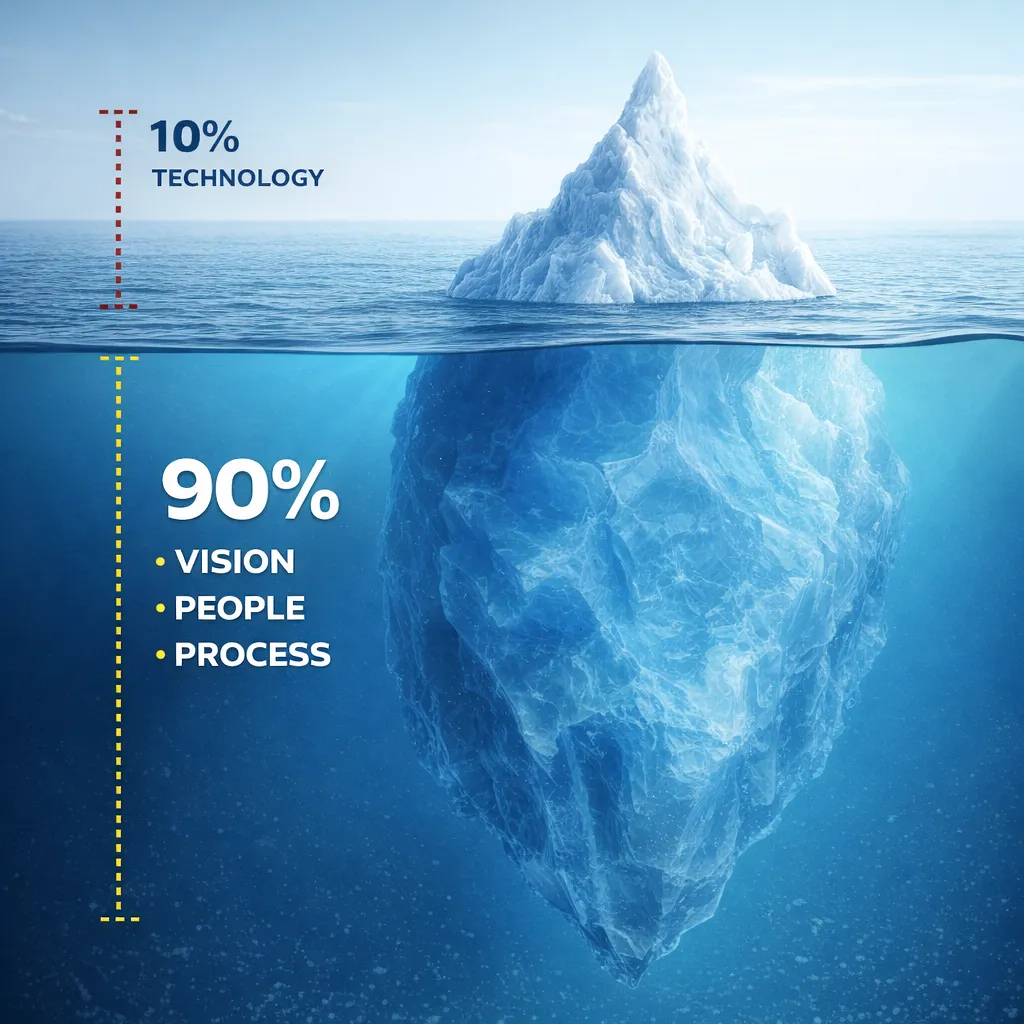
So most businesses copy the visible 10 percent and skip the invisible 90 percent.
The Sequence That Creates Alignment
High-performing businesses build in this order:
Vision (20%) → People (25%) → Process (45%) → Technology (10%)
These percentages aren’t theory. They reflect where the real work happens.
Most companies spend the majority of their effort on tools and tactics.
The best ones spend the majority of their effort clarifying Vision, People, and Process.
Technology becomes simple when the first three are clear.
Vision (20%): Define the Outcome, Not the Service
Vision is not your mission statement.
It’s not your list of services.
Vision is what your customer stops worrying about after working with you.
Weak Vision:
“We provide consulting services to growing businesses.”
Clear Vision:
“Leaders stop feeling stuck because they finally have clarity on what matters and how to execute it.”
One describes what you do.
The other describes the result.
When Vision is clear:
Messaging has direction
Content stops sounding generic
Teams know what success actually looks like
When Vision is vague, everything defaults to features, credentials, and buzzwords.
Quick test:
If you removed your company name from your marketing, would someone still know it’s you?
If not, Vision isn’t clear yet.
People (25%): Strategic DNA, Not Demographics
Most businesses define their audience by surface details:
Industry
Revenue
Job title
Age range
That’s not strategy. That’s classification.
Strategic DNA answers deeper questions:
How do they make decisions?
What do they value most?
What do they fear losing?
What creates trust for them?
Two customers can look identical on paper and behave completely differently.
One values certainty and long-term stability.
Another values speed and flexibility.
Same demographics.
Completely different buyers.
When you understand strategic DNA, your messaging naturally attracts the right people and repels the wrong ones.
Process (45%): Trust Architecture, Not Funnels
Process is where most businesses struggle.
Not because it’s complicated, but because it’s invisible.
Process is not a funnel.
It’s not a sequence of emails.
Process is how trust is built over time.
It answers questions like:
How do we educate without overwhelming?
How do we follow up without chasing?
How do we demonstrate competence before asking for commitment?
How does our team execute consistently without heroics?
If only one person can “make it work,” you don’t have a process.
You have a dependency problem.
Process is what allows trust, quality, and clarity to scale.
Why AI and Content Tools Sound Generic
This is why most AI-generated content feels interchangeable.
AI doesn’t sound generic because the tools are bad.
It sounds generic because it has nothing strategic to pull from.
If Vision is vague, People are undefined, and Process is unclear, AI can only guess.
When AI is trained on real foundations, it stops guessing and starts reinforcing how your business actually thinks and operates.
The difference isn’t better tools.
It’s better foundations.
Technology (10%): Implementation, Not Strategy
Technology is the final layer.
Once Vision, People, and Process are clear, technology decisions become obvious.
The CRM supports the process you already mapped
Automation follows a trust journey you already designed
Content tools reflect how your customers think
Start with technology and you rebuild.
Start with Vision and technology becomes execution.
Common Signs You Started With Tools
Your CRM feels forced
Your website attracts the wrong prospects
Your messaging sounds like everyone else
Prospects engage early, then disappear
Your team avoids follow-up
Every new tool creates more work
These aren’t execution problems.
They’re sequence problems.
What to Fix First This Week
You don’t need to rebuild everything.
Start here:
Step 1: Define Vision (2 hours)
What does your customer stop worrying about after working with you?
Step 2: Audit People (1 hour)
Look at your last 10 clients. Identify shared decision patterns.
Step 3: Map Process (1 hour)
Document how trust is built from first contact to commitment.
Step 4: Evaluate Technology (30 minutes)
Are tools supporting your process, or dictating it?
The Choice
You can keep rebuilding every six months.
Or you can build Vision, People, and Process first, and let technology become the easiest part.
Most businesses learn this through trial and error.
The best ones learn it by design.
Next Step
If you want clarity on where your business stands:
No pitch. No pressure. Just clarity.






Copyright © 2023 - align business strategies. All rights reserved.